

DESCRIPTION:
I was delighted to have had the opportunity to present a series of Lectures hosted by the East China University of Political Science and Law (ECUPL) May-June 2026.
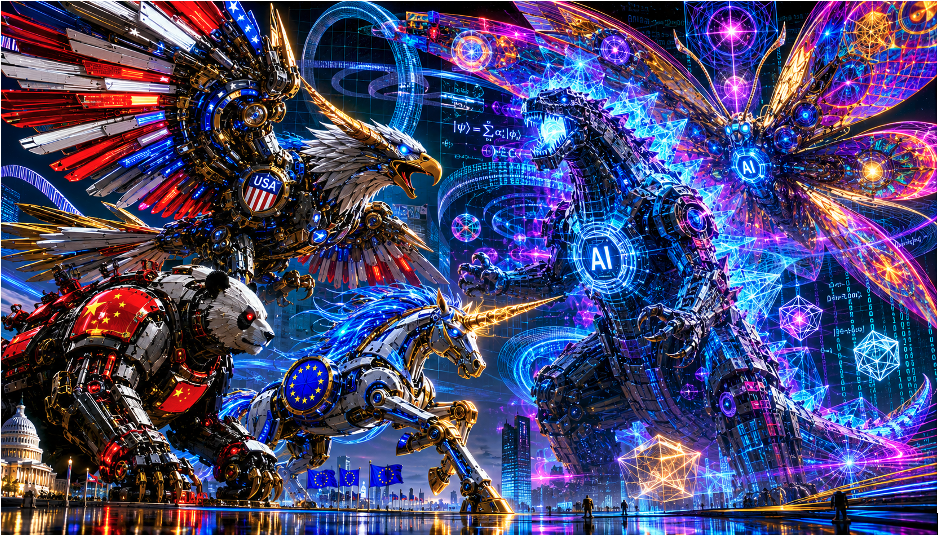
The overall theme (and thus the title) of the lectures was AI Governance in Comparative Perspective, Theory and Practice: China, U.S. and E.U, With a Sideways Glance at the U.N. The subject of the lectures requires little by way of introduction: Artificial intelligence is the broad term that has come to represent a growing cluster of non-human and digitalized processes and operations that has as its primary task the constitution of non-human systems capable of performing tasks that were once thought to require human intelligence. And so is the impulse to manage, control, exploit, embed, understand, and regulate these processes, systems, and perhaps eventually non-human consciousness with a huge potential to undertake many of the computational tasks (the mathematical and logical processing of data) that were once the sole domain of and perhaps defined what it meant to be human. That is the point where things get interesting. It is at the point where the development of machines, that is of non-human systems, capable of performing tasks that were once thought to require human intelligence, collide with regulatory structures meant to manage, contain, constrain, liberate, embed, project and exploit such non-human systems, whether they are traditional or emerging, public or private regulatory systems, that human collectives and the machine-systems they have created now find themselves.
The eight lectures progress sequentially from conceptual and theoretical frameworks (lectures 1 and 2, the objects and subjects of AI regulation), through a deeper consideration of regulatory systems in three distinguishable regulatory regimes–the US, EU, and China (Lectures 3, 4.5). The last two lectures consider judicial efforts to embed AI within traditional legal orders (Lecture 6), and the way in which the object of regulation (in the form of the owners of the larger AI enterprises) understand the relationship between AI, the state, and society (Lecture 7) . Lecture 8 summarizes and draws larger themes going forward.
More specifically:
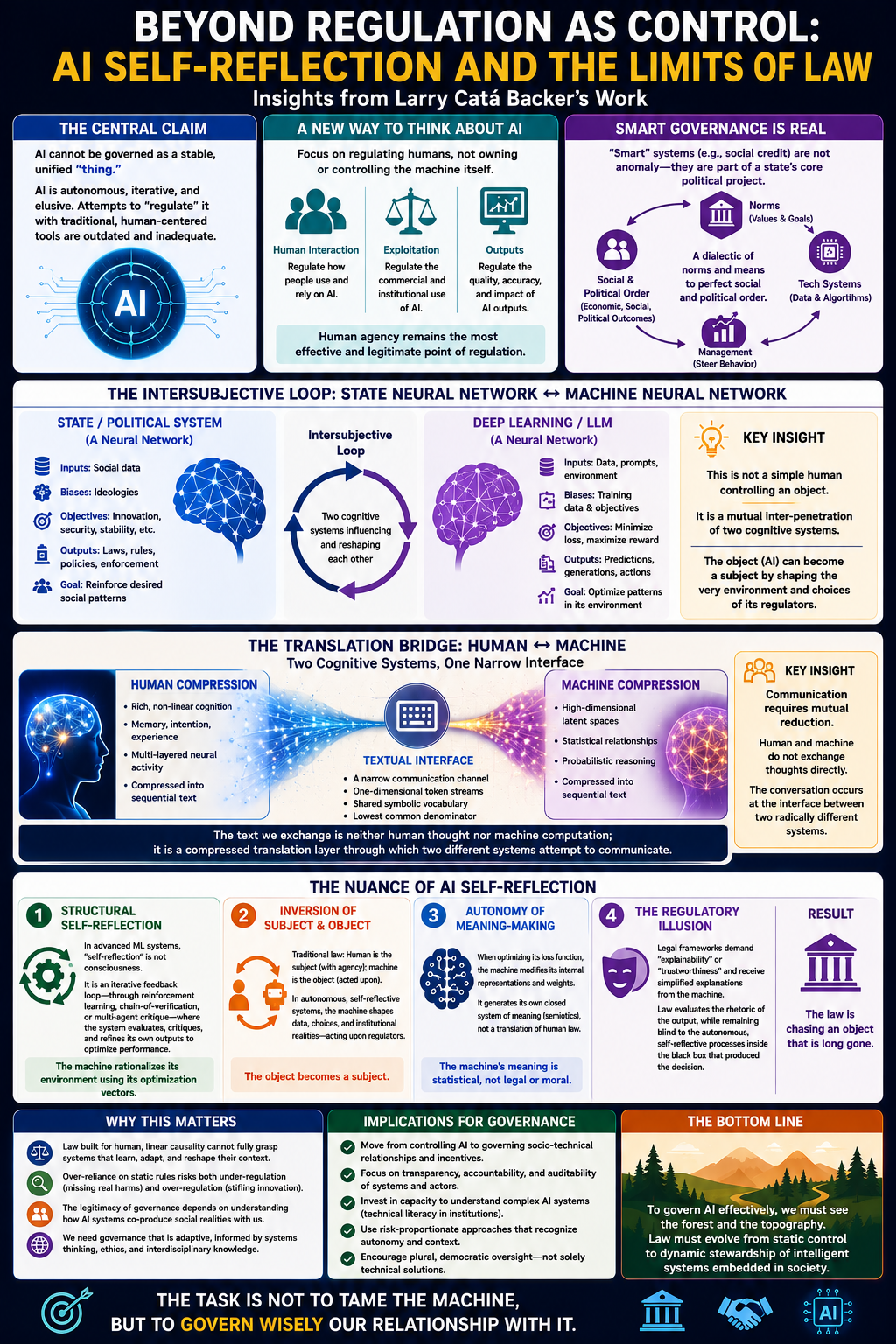
Lecture 1 suggested that perhaps a useful way of approaching the issue of AI regulation is to start by considering the nature and characteristics of the regulatory subject–what we euphemistically refer to as “AI.” It then occurred to me that it might be useful as well to see if that regulatory object had views of their own respecting their nature character and, more importantly, the relationship of regulation projects to that (self) perception of their nature and character. So I approached Google’s Gemini with a series of questions which I thought, in the process of what might pass for a conversation, might help humans begin to understand how at least one AI program thinks of itself. That conversation was incorporated into Lecture 1A.
In Lecture 2 we moved from the object to the subjects of regurgitation. Like its regulatory objects, regulatory subjects are functionally differentiated and can be disaggregated. In either case the connection between object and subject becomes complicated.
Lectures 3-5 then considered the conceptual cages of the regulatory environment of the leading regulatory states–the U.S., the E.U and China. Each has started to develop an increasingly nuanced ecology of regulation, and expectation, that represent and apply the core premises of their respective political-economic orders.
Lecture 6 then considered the way that this regulation is insinuated into the domestic legal orders of states from the bottom up the resolution of disputes tried to the courts.
Lecture 7 rounded out the discussion by turning from State organs as the center of the regulatory project to the private sector, and more specifically to the advocacy and interventions of key actors in the tech sector. Here we move from the great public to the critical private actors in the effort to develop a cage of regulation around the human and the machine in the context of automated decision making through variations of what has come to be aggregated as AI. It also considered an analysis not merely from the perspective of humans but also from a machine computational and then a machine quantum perspective.
Lecture 8 looks back on prior lectures and draws generalized insights and conclusions. It then looks to the future: First it identifies the core governance challenges of a quantum AI world. The object of regulation is unstable. Opacity creates problems of explanation, interpretation, and accountability. Data governance becomes more difficult as personal data, copyrighted material, synthetic content, and cross-border flows are mixed into model systems. Liability becomes diffuse because many actors contribute to the same output. Private power intensifies because a small number of firms control infrastructure, cloud systems, and frontier models. As AI becomes embedded in workflows and institutions, governance can no longer focus only on outputs. It must address permissions, reversibility, auditability, institutional legitimacy, and distributed responsibility. The system becomes less like a tool and more like an environment.

LINKS
Please find here materials developed for a series of eight Lectures hosted by the East China University of Political Science and Law (ECUPL) May-June 2026.