

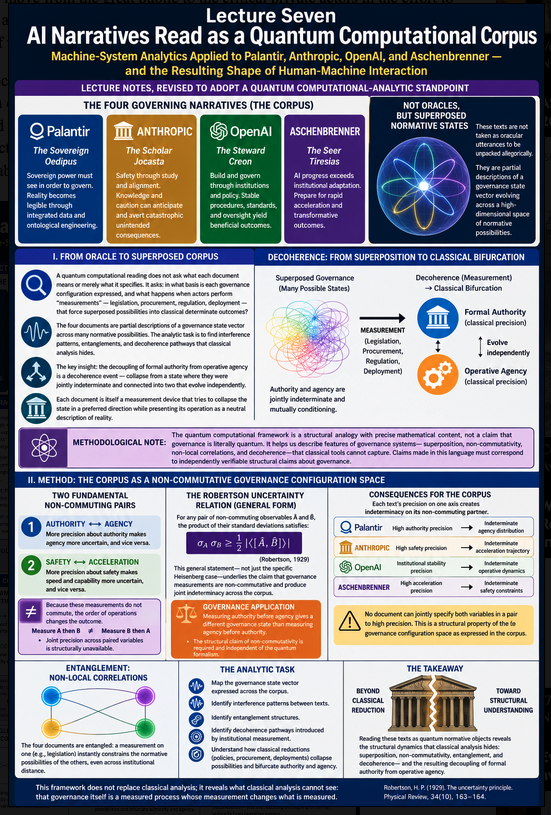
This page includes a summary of the Lecture 7 Notes, as well as the link to the Lecture 7 PPT. Those interested may reach out to me to discuss availability of audio of the lecture and the full text of the Lecture 7 notes. Here we move from the great public to the critical private actors in the effort to develop a cage of regulation around the human and the machine in the context of automated decision making through variations of what has come to be aggregated as AI. The Lecture rounded out the discussion by turning from State organs as the center of the regulatory project to the private sector, and more specifically to the advocacy and interventions of key actors in the tech sector. Here we move from the great public to the critical private actors in the effort to develop a cage of regulation around the human and the machine in the context of automated decision making through variations of what has come to be aggregated as AI. It also considered an analysis not merely from the perspective of humans but also from a machine computational and then a machine quantum perspective.
Given the nature of the project I thought it might be useful to engage with an commercially available AI service for the production of a summary of the Lecture 1 materials. After some back and forth with Claude again (Lecture 6 used Gemini again, Lecture 5 used Perplexity; Lecture 4 used Grok; Lecture 3 used Anthropic’s Claude; Lecture 2 used Chat GPT; Lecture 1 and 1A used Google’s Gemini), we came up with the following abstract of Lecture 7.
Lecture 7 Abstract:
The materials develop a comparative account of AI governance as a struggle over the constitution of authority within and among human collectives, rather than as a merely technical problem of regulating tools. Their core insight is dialectical: AI systems are shaped by the political orders that produce and deploy them, yet these same systems recursively reshape the institutional, cognitive, and normative environments of those orders. From that premise follows the central dispute running through the presentation – who governs, at what moment governance occurs, and whether the dominant values embedded in governance regimes remain recognizably human, become state-instrumental, or migrate toward machine-mediated autonomy.
Within that framework, Palantir appears as the exemplar of internal state transformation. Its narrative does not treat AI chiefly as an external market commodity or as an abstract universal innovation. Rather, it situates AI within the administrative apparatus of government itself. The implication is that the inherited state form is too slow, fragmented, and informationally disaggregated to govern effectively under contemporary conditions. AI therefore becomes an instrument through which the state is rationalized, integrated, and rendered operationally coherent. But this is not simply a matter of efficiency. The deeper claim is constitutional: human governance must be re-engineered to conform to the decision architectures made possible by AI. In that sense, Palantir’s model remains human-led, yet only on the condition that the human collective reorganize itself around machine-compatible structures of visibility, coordination, and action.
Anthropic, by contrast, externalizes the problem and places AI within a geopolitical field of civilizational competition. Here AI is reduced, strategically and unapologetically, to an instrument of state power. The key issue is not internal administrative modernization but the preservation of democratic advantage against authoritarian rivals, above all China under CCP leadership. Compute, export controls, model distillation, and lead-time become the vocabulary through which political order is imagined and defended. AI governance, in this narrative, becomes inseparable from industrial policy, national security, and the management of technological asymmetries. What matters is not AI as such, but whether democratic states can dominate the infrastructures through which AI capability is produced, and thereby ensure that liberal political orders rather than authoritarian systems shape global norms.
OpenAI occupies a different ideological space. Its materials suggest a politics of transformative preservation: society is to be deeply altered by AI while remaining insulated from the disruptive social consequences of that alteration. This is a distinctly American technocratic imaginary. It seeks neither the hard securitization of Anthropic nor the state-apparatus restructuring of Palantir, but rather the managed continuity of the social order through expert-guided adaptation. Economic openness, resilience, and institutional cushioning become the mechanisms through which foundational transformation is rendered publicly tolerable. The result is a paradoxical program of change designed to preserve sameness – a reconstruction of society that leaves intact its legitimating surfaces and governing mythologies.
The Aschenbrenner position (Situational Awareness) radicalizes these tendencies by projecting superintelligence as the generator of an inevitable national security state. In that view, the only remaining question is whether humans will direct that emergent order or whether autonomous AI domains will progressively displace them.
Taken together, these narratives reveal that AI governance is better understood as a contest over social ordering, political legitimacy, and the allocation of authority in an era when the governors are themselves increasingly shaped by the systems they claim to govern.
To make the lecture more interesting, and because of the nature of the materials covered–in this case the interventions of the elite AI providers and thought drivers–I thought it would make sense to alter the cognitive cage of analysis. Rather than just approach the questions raised by Palantir, Anthropic, OPenAI and Aschenbrenner from a human (hermeneutic/semiotic) perspective, I also interacted with Claude to produce the same lecture first from a machine computational framework and then from a machine quantum framework. The human framework was grounded in the relationship between fact and faith, temporally constrained as textually bound sequences of nodal thought clusters strung along irreversible linear pathways (the essential character of the human analytic mind as block chain). The computational framework, on the other hand, was indifferent to belief and focused on construction from out of the patterned computational structures from out of which it operated.
The way the two views observe/understand at each other through the keyhole of compressed and reductive communication (the object of Lecture 1A), might help us understand the nature of the emerging machine-human dialectic and its inter-subjectivities.
This is how Claude and I saw it:
What distinguishes the three readings is what each can and cannot find. The hermeneutic reading recovers what each narrative seeks to be believed. The classical computational reading identifies what each architecture operationalizes irrespective of what it seeks to be believed. The quantum computational reading specifies what each architecture forecloses through the decoherence its own deployment produces — the superposed governance possibilities that the act of operationalizing any one configuration necessarily destroys — and identifies the structural incompatibility between human temporal ordering and quantum computational dynamics that no document in the corpus names as a variable requiring governance.
The convergent structural finding of the quantum computational reading is that the four architectures do not disagree about whether human authority should be preserved; they converge on governance structures in which formal human authority is retained as an interface property while the operative dimensions of that authority are progressively collapsed by the decoherence dynamics each architecture itself instantiates. The further finding — supplied by the temporal analysis — is that this collapse proceeds not merely because of inadequate governance design but because the temporal structure of human governance and the temporal structure of AI capability development are incommensurable in ways that no governance design operating within human sequential-nodal-linear time can fully address.
The three versions of the Lecture notes follow.