

Lecture Series: AI Governance in Comparative Perspective, Theory and Practice: China, U.S. and E.U, With a Sideways Glance at the U.N. (2026)
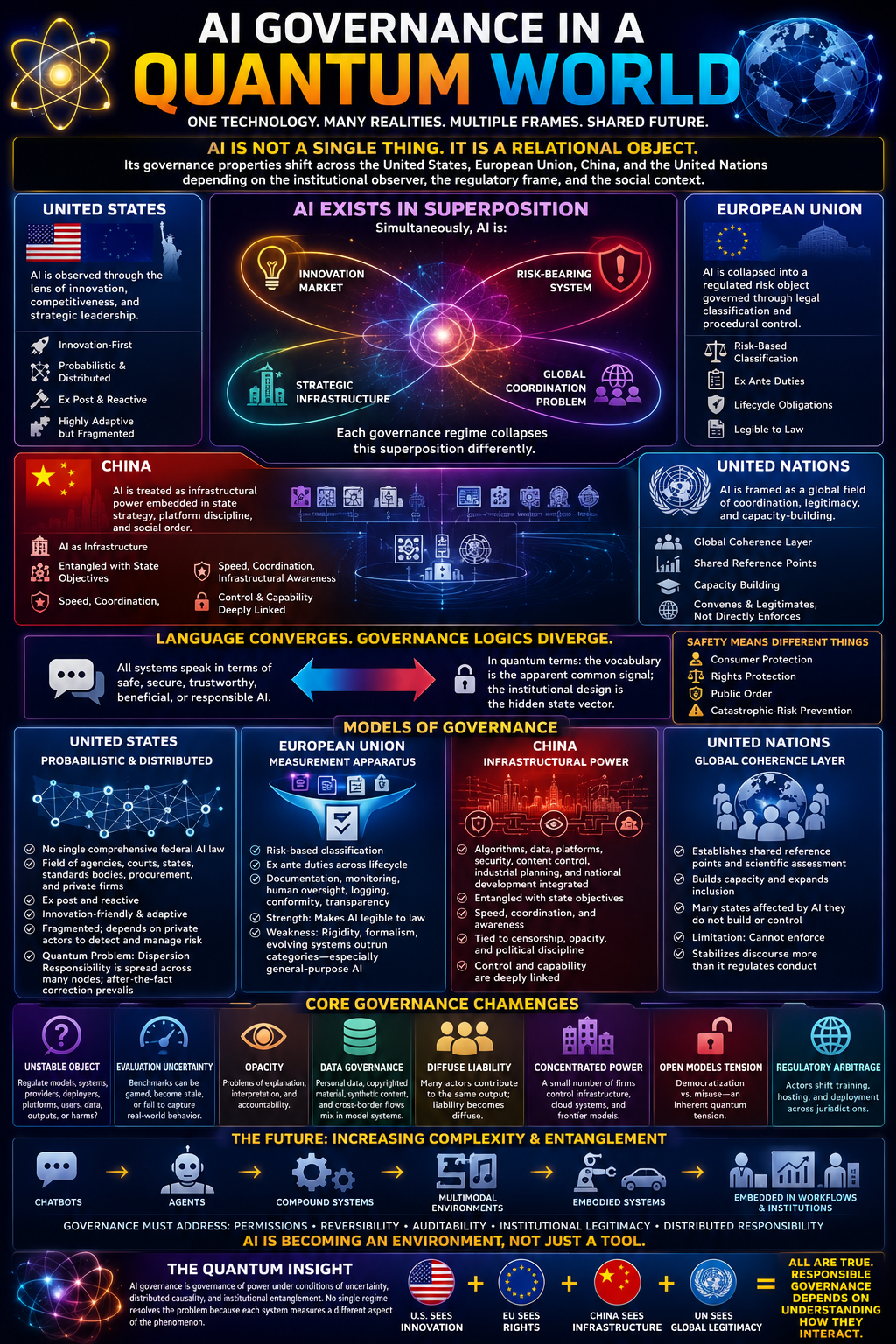
This page includes a summary of the Lecture 8 Notes, as well as the link to the Lecture 8 PPT. Those interested may reach out to me to discuss availability of audio of the lecture and the full text of the Lecture 8 notes. The lecture looks back on prior lectures and draws generalized insights and conclusions. It then looks to the future: First it identifies the core governance challenges of a quantum AI world. The object of regulation is unstable. Opacity creates problems of explanation, interpretation, and accountability. Data governance becomes more difficult as personal data, copyrighted material, synthetic content, and cross-border flows are mixed into model systems. Liability becomes diffuse because many actors contribute to the same output. Private power intensifies because a small number of firms control infrastructure, cloud systems, and frontier models. As AI becomes embedded in workflows and institutions, governance can no longer focus only on outputs. It must address permissions, reversibility, auditability, institutional legitimacy, and distributed responsibility. The system becomes less like a tool and more like an environment.
Given the nature of the project I thought it might be useful to engage with an commercially available AI service for the production of a summary of the Lecture 1 materials. After some back and forth with Perplexity (Lecture 7 used Claude again; (Lecture 6 used Gemini again, Lecture 5 used Perplexity; Lecture 4 used Grok; Lecture 3 used Anthropic’s Claude; Lecture 2 used Chat GPT; Lecture 1 and 1A used Google’s Gemini), we came up with the following abstract of Lecture 8.
Lecture 8 Abstract:
This lecture series compares AI governance in the United States, European Union, China, and the United Nations. Its central argument is that these systems share a common vocabulary of safe, secure, trustworthy, and beneficial AI, but they differ sharply in how they define AI, allocate authority, and justify governance. AI is not treated as a single universal object. Instead, each system constructs AI differently: as an innovation market and strategic asset in the United States, as a risk-bearing legal object in the European Union, as strategic infrastructure in China, and as a global coordination problem at the United Nations.
The lecture emphasizes several shared themes. All systems now recognize that AI can create serious risks, including discrimination, misinformation, cyber abuse, surveillance, privacy violations, and concentration of power. All see transparency, accountability, standards, and data governance as important. All also recognize that general-purpose AI complicates regulation because the same model can be deployed in many different contexts. At the same time, the systems differ in institutional design. The United States relies on fragmented sectoral governance and often acts after harm occurs. The European Union uses a risk-based, ex ante, lifecycle approach grounded in rights and procedural supervision. China uses party-state coordination, administrative speed, and integration of AI policy with industrial and security goals. The United Nations seeks legitimacy through inclusive global dialogue, capacity-building, and scientific assessment.
The lecture then assesses strengths and weaknesses. The U.S. model is flexible and innovation-friendly but fragmented and dependent on private governance. The EU model offers legal clarity and rights protection but can be complex and slow. China’s model sees AI as infrastructure and can act quickly, but it is tied to political control and opacity. The UN model is inclusive and globally legitimate, but it lacks enforcement power and moves slowly.
A major concern is that AI governance is shifting from regulation of isolated models to regulation of infrastructure, systems, and institutions. Future AI will be agentic, multimodal, embodied, and deeply embedded in schools, hospitals, courts, workplaces, and public administration. This raises harder questions about liability, evaluation, data, open models, regulatory capacity, and cross-border arbitrage. The lecture concludes that AI governance is really governance of power moving through technology, and that no single system fully solves the problem.