

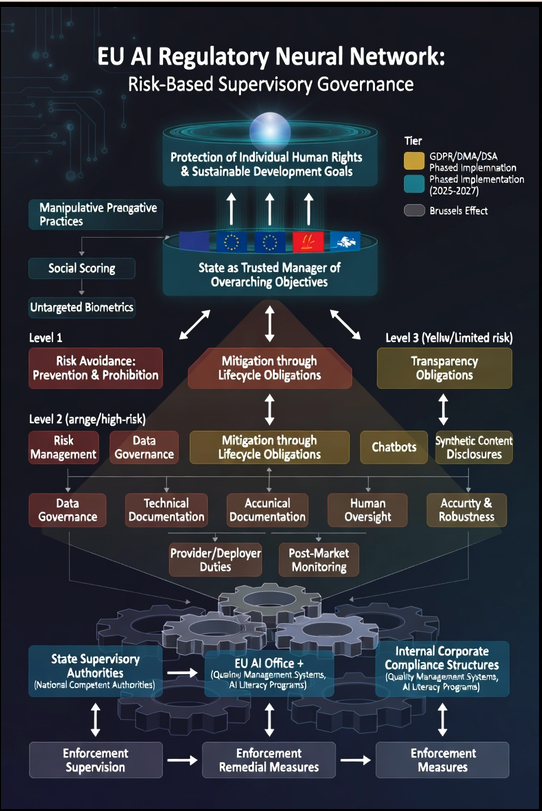
This page includes a summary of the Lecture 4 Notes, as well as the link to the Lecture 4 PPT. Those interested may reach out to me to discuss availability of audio of the lecture and the full text of the Lecture 4 notes. The EU approach transcends narrow technology policy. It reflects a distinctive European regulatory imagination in which markets are constituted and disciplined through law, high-impact systems are subjected to continuous supervision, and technological trajectories are required to remain compatible with the Union’s commitments to fundamental rights.
Lecture 4 Abstract: The European Union’s Risk-Based Supervisory Governance of Artificial Intelligence
The European Union has constructed a comprehensive regulatory architecture for artificial intelligence centered on the Artificial Intelligence Act (AI Act), a risk-based instrument that classifies systems according to their potential effects on health, safety, fundamental rights, and the internal market. This framework integrates with the General Data Protection Regulation (GDPR) on data privacy and automated decision-making, the Digital Markets Act (DMA) addressing gatekeeper conduct, and the Digital Services Act (DSA) concerning platform accountability. The EU model embeds AI governance within a broader regulatory imagination in which markets are constituted through law, high-impact systems receive ongoing supervision, and technological development aligns with fundamental rights.
The lecture’s central thesis holds that the EU renders AI legally legible through ex ante classification, risk assessment, and lifecycle obligations rather than primarily ex post responses to harm. This supervisory governance model contrasts with the more fragmented, market-oriented U.S. approach, which often translates harms into existing legal categories after deployment via agencies, litigation, and standards. The EU architecture identifies prohibited practices, high-risk systems, transparency obligations, and general-purpose AI requirements, allocating responsibilities among providers, deployers, importers, and distributors.
The AI Act functions as a risk pyramid. Prohibited practices—certain manipulative techniques, social scoring, and biometric applications—embody non-negotiable limits grounded in EU values. High-risk systems, used in employment, education, critical infrastructure, law enforcement, and essential services, trigger extensive lifecycle obligations: risk management, data governance, technical documentation, logging, human oversight, accuracy, robustness, cybersecurity, post-market monitoring, and incident reporting. Lower tiers impose transparency duties for chatbots or synthetic content, while minimal-risk systems face few burdens. This scaling acknowledges differential stakes but raises classification challenges for multi-purpose or context-shifting systems.
The provider-deployer distinction seeks to close accountability gaps: providers handle design and documentation; deployers manage contextual use and oversight. For general-purpose AI and foundation models, upstream obligations address technical documentation, systemic-risk mitigation, and downstream information flows, recognizing their infrastructural role beyond single use cases. Complementary provisions emphasize AI literacy for personnel and staged implementation from February 2025 to August 2027.
The EU approach fuses product-safety logics (conformity assessment, market surveillance) with fundamental-rights supervision (non-discrimination, dignity, autonomy). Strengths include regulatory harmonization, the “Brussels effect” on global compliance, and explicit lifecycle accountability. Weaknesses encompass classification complexity, compliance burdens on smaller entities, potential formalism, enforcement variability, and the risk that managerial techniques displace deeper contestation over power and democracy. Rapid technical evolution further tests adaptability.
Comparatively, the EU and U.S. systems organize shared concerns—innovation, safety, rights—through divergent logics: supervisory risk governance versus monitored market governance. The EU AI Act represents an ambitious effort to make AI governable through legal classification and obligation. Its success depends on whether this architecture can sustain coherence amid rapid change while protecting rights and supporting innovation.