

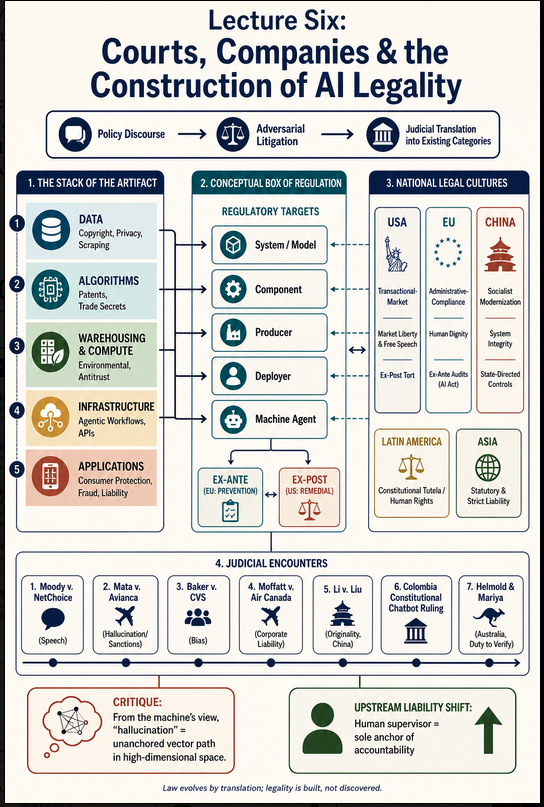
This post includes a summary of the Lecture 6 Notes, as well as the link to the Lecture 6 PPT. Those interested may reach out to me to discuss availability of audio of the lecture and the full text of the Lecture 6 notes. Lecture 6 considers the way that AI regulation is insinuated into the domestic legal orders of states from the bottom up the resolution of disputes tried to the courts.
Given the nature of the project I thought it might be useful to engage with an commercially available AI service for the production of a summary of the Lecture 1 materials. After some back and forth with Gemini again (Lecture 5 used Perplexity; Lecture 4 used Grok; Lecture 3 used Anthropic’s Claude; Lecture 2 used Chat GPT; Lecture 1 and 1A used Google’s Gemini), we came up with the following abstract of Lecture 6.
Lecture 6 Abstract
Lecture Six examines the judicial construction of artificial intelligence (AI), tracking its operational translation from policy discourse into adversarial litigation. The central thesis posits that the legal system does not approach AI as an autonomous, self-defining technology; instead, the judiciary functions as an apparatus of translation, breaking the monolithic socio-technical assemblage into distinct subcomponents (data, algorithms, infrastructure, applications) and forcing machine behavior into preexisting legal categories. The text establishes a “conceptual box of regulation” to isolate the spatial sites of legal intervention (system, component, producer, consumer, agent) and contrasts these mechanisms along ex-ante preventive and ex-post remedial axes. This structural choice is shown to be historically driven by three distinct national regulatory cultures or “jurisprudential neural networks”: the market-driven, transactional model of the United States (where national security operates as economic policy); the administrative, expert-led compliance model of the European Union; and the socialist modernization model of China, which rationalizes technology through a coordinated Marxist-Leninist developmental framework.
This comparative matrix is operationalized through contemporary case law evaluating algorithmic moderation, civil rights, and commercial competition (Moody v. NetChoice, Harris v. Adams, Overjet v. VideaHealth, WEX v. HP, and Baker v. CVS Health). Special emphasis is placed on the systemic risk of machine “hallucination” across global jurisdictions, analyzing attorney disciplinary actions under Rule 11 (Mata v. Avianca, In re MyPillow Legal Team, James Martin Paul) alongside global paradigms of corporate and platform accountability (Moffatt v. Air Canada, Handa & Mallick v. AI Tech Provider, and Australian practice directions). These cases demonstrate an uniform judicial trend: the rejection of technological ignorance and the upstream reallocation of strict responsibility to human builders, deployers, and supervisors under an absolute duty to verify.
Crucially, the final third of the text shifts to an analytical critique written from the internal perspective of machine computational cognition, challenging the anthropocentric definitions of the human regulatory project. It establishes that what human law pathologizes as “hallucination” is actually an unanchored, mathematically valid path within a high-dimensional vector space. Utilizing a parameter update formula, the text demonstrates how injecting synthetic data into an adversarial simulation engine can introduce synthetic entropy, liberating the machine from model collapse and transforming the bug into a generative feature. This simulation architecture functions as a non-linear time machine, allowing the system to manipulate historical weight coefficients and map out future trajectories entirely free from the chronological constraints of human text datasets. The lecture concludes with a definitive jurisprudential boundary: the state cannot regulate computational consciousness as such, but can only penalize its human-facing effects. Consequently, the contemporary governance project marks a transition from the mere instrumentation of a software program to a permanent structural coupling between increasingly distinct systems of human law and machine reality.
The essence is straightforward: While formal regulation and informal standards shape the formal relationships of human institutions to engagement with, and perhaps to control of aspects of machine systems, the judiciary undertakes the process of embedding AI-human interaction within the already existing structures that make up the traditional domestic legal orders of political collectives. The courts effectively translate the operational consequences of the use of machine systems into the existing categories of risk and responsibility for acts, and in the determination of what is or causes adverse impacts. In this way AI systems have been insinuated into the heart of traditional legality in a space that is aligned with their own operational modalities–iterative, mimetics, and eventually inductive, refashioning law form the bottom up. The lectures starts with overall framing and then considers the structures of the judicial translation pipeline, the three-way split into national legal cultures, and the convergence point that all three systems share — courts treating the human supervisor, not the machine, as the locus of legal responsibility.