

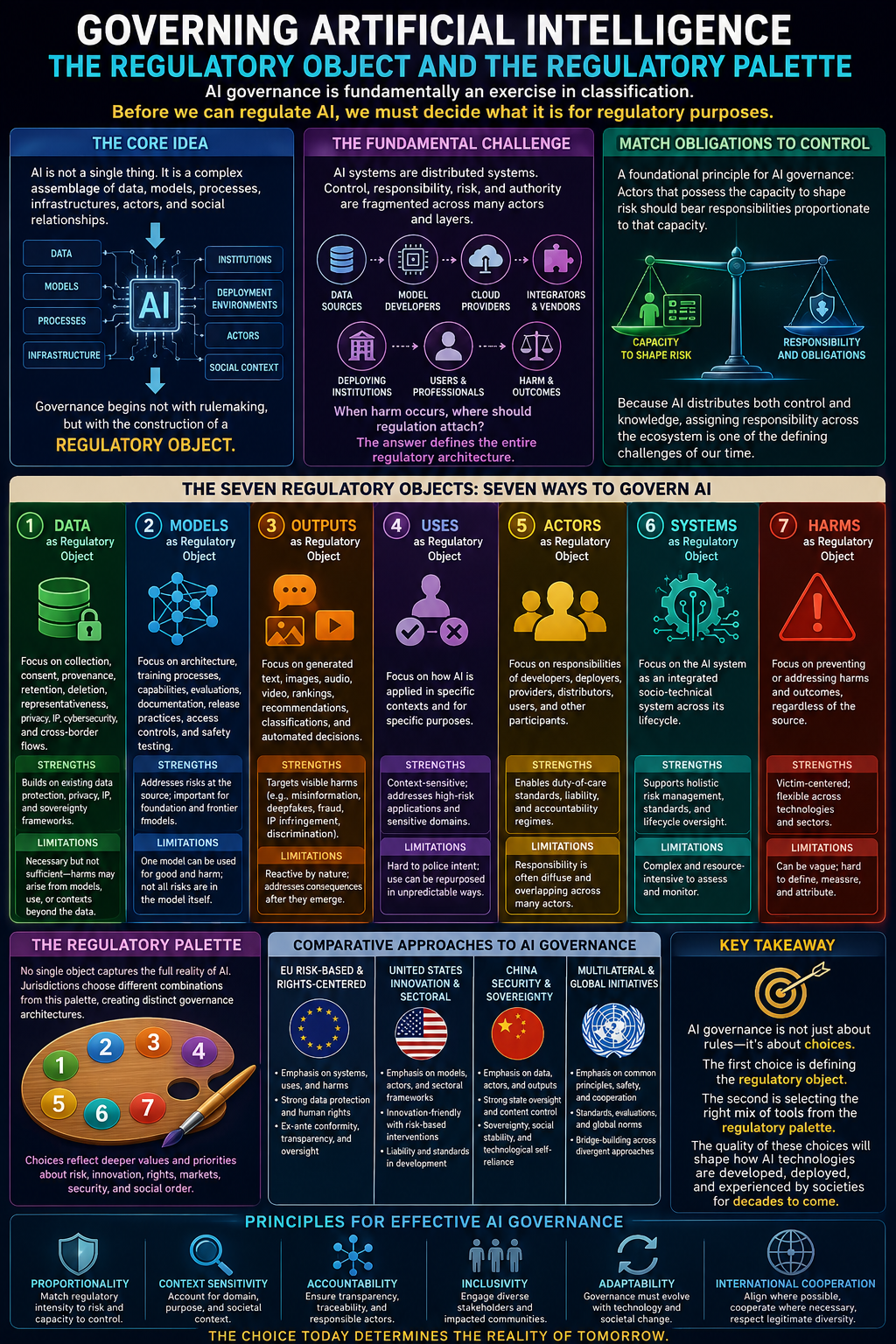
This page includes a summary of the Lecture 2 Notes, as well as links to the Lecture 2 PPT. Those interested may reach out to me to discuss availability of audio of the lecture and the full text of the Lecture 2 notes. The lecture proposes a useful organizing principle: governance seeks to match obligations to control. Actors that possess the capacity to shape risk should bear responsibilities proportionate to that capacity. Yet because AI systems distribute both control and knowledge across multiple layers, assigning responsibility becomes one of the defining challenges of contemporary governance.
Lecture 2 Abstract
Lecture Two argues that artificial intelligence governance is best understood not as the regulation of a single technology but as the selection and deployment of a regulatory palette. AI is neither a unified object nor a stable category. Rather, it comprises interconnected layers of data, models, training processes, deployment systems, institutional practices, infrastructures, and human actors. Consequently, the central challenge of governance is not whether AI should be regulated, but determining what aspect of the AI ecosystem is to become the object of regulation and through what mechanisms governance will be exercised.
The lecture’s core contribution is the development of a framework that distinguishes between regulatory objects and regulatory modalities. Regulatory objects identify what is being governed. The lecture highlights seven principal candidates: data, models, outputs, use cases, actors, harms, and infrastructure. Each object produces a distinct governance orientation. Data-centered approaches focus on privacy, consent, provenance, intellectual property, and data sovereignty. Model-centered approaches emphasize training practices, safety evaluations, documentation, and capability assessments. Output-oriented governance addresses generated content, recommendations, rankings, and automated decisions. Use-case approaches assess risk according to social context, particularly in sectors such as healthcare, education, employment, and public administration. Actor-centered governance allocates obligations across developers, deployers, vendors, and users. Harm-based approaches focus on discrimination, fraud, deception, privacy violations, and other legally cognizable injuries. Infrastructure-centered governance treats AI as a strategic capability dependent on chips, cloud computing, energy systems, and technological supply chains.
The lecture then examines the principal modalities through which these objects may be governed. Market governance relies on competition, consumer choice, procurement, and ex post enforcement. Risk-based governance classifies systems according to their potential impacts and imposes obligations proportionate to those risks. Rights-based governance centers the protection of affected individuals through privacy, equality, due process, explanation, and remedy. Safety and assurance governance emphasizes testing, robustness, auditing, monitoring, and lifecycle management. Platform and content governance focuses on information ecosystems, recommender systems, synthetic media, and public discourse. Industrial-strategic governance treats AI as a national capability linked to economic competitiveness, technological sovereignty, and geopolitical power.
This framework provides the foundation for comparative analysis. The United States, the European Union, and China do not merely adopt different AI rules; they construct different regulatory objects and deploy different governance modalities. The United States tends to govern through markets, harms, litigation, sectoral regulation, and national-security authorities. The European Union privileges risk classification, administrative supervision, transparency, and fundamental-rights protection. China integrates platform governance, content control, data governance, industrial policy, and state-directed technological development. The same technical system may therefore appear as a consumer product, a rights-based risk, a platform function, or a strategic infrastructure asset depending on the governing framework.
The lecture concludes that AI governance is ultimately an exercise in political ordering. Decisions about what AI is, what aspects matter most, and what governance tools are appropriate reveal competing visions of social organization. The central question is therefore not how much AI should be regulated, but what conception of society regulation seeks to advance through the governance of AI.
