

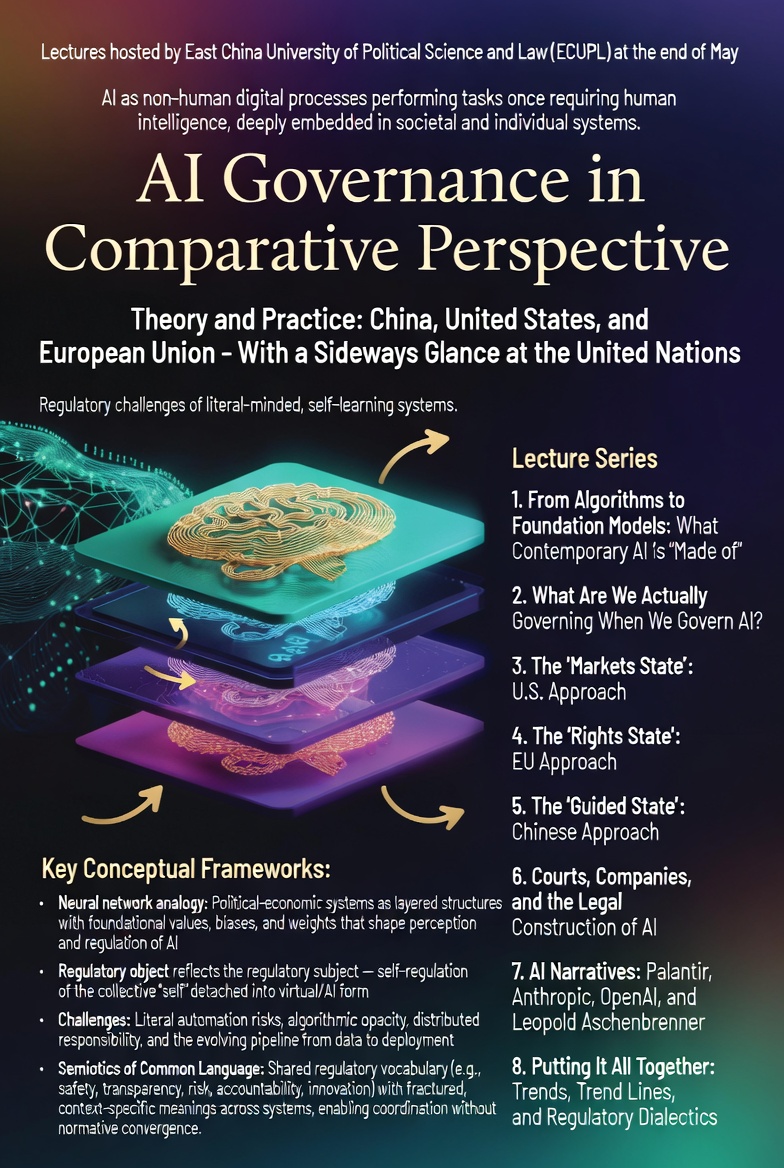
The overall theme (and thus the title) of the lectures was AI Governance in Comparative Perspective, Theory and Practice: China, U.S. and E.U, With a Sideways Glance at the U.N. The subject of the lectures requires little by way of introduction: Artificial intelligence is the broad term that has come to represent a growing cluster of non-human and digitalized processes and operations that has as its primary task the constitution of non-human systems capable of performing tasks that were once thought to require human intelligence. AI has come to dominate , or infect, depending on one’s point of view, virtually every aspect of the organization and operation of collective human systems—as well as shaping the lives of individuals who are plugged into virtual systems of decision making or automated processes that can provide everything from entertainment, to advice, to interaction with other humans and organizational structures.
This is well known as is its capacity for literal impact. One is reminded of Norbert Wiener’s reference to the classic horror tale, the Monkey’s Paw, in his book God & Golem, Inc.: A Comment on Certain Points Where Cybernetics Impinges on Religion(MIT Press, 1964, pp. 58-60). The tale describes the risk of wishing for or demanding something from a source that is entirely literal minded, which in the case of the Monkey’s Paw was meant to grant three wishes, the means to those ends were undefined. When a person wished for
a sum of money, the wish was granted, in the form of a settlement by their son’s employer as a consequence of an accident that killed the son.
In Wiener’s words: “The magic of automation, and in particular the magic of automatization in which devices learn, may be expected to be similarly literal. If you are playing a game according to certain rules and set the playing-machine to play for victory, you will get victory if you get anything at all, and the machine will not pay the slightest attention to any consideration except victory according to the rules.” (Ibid.); unless, of course the rules are constantly changing to embed more and more complex considerations. When the machine becomes self-learning, it can develop its own mechanisms for adding or subtracting considerations as well (rules, norms, values, etc.).
The Lectures start from the premise that before it is even possible to speak about regulation and regulatory systems, and even more so to speak of such systems in or as some sort of comparison (against what standard is yet another problem of course), one must first have firmly in mind two of the critical elements on which any such discussion might be organized. The first requires an effort to grasp, or perhaps better to approach an understanding of, the object of regulation. The second is to have some better sense of the regulatory enterprise, especially its forms, placement, approaches, characteristics and logic; and noy just its forms but its sources and the character of its authority within regulatory collectives including but not limited to the governmental apparatus.