

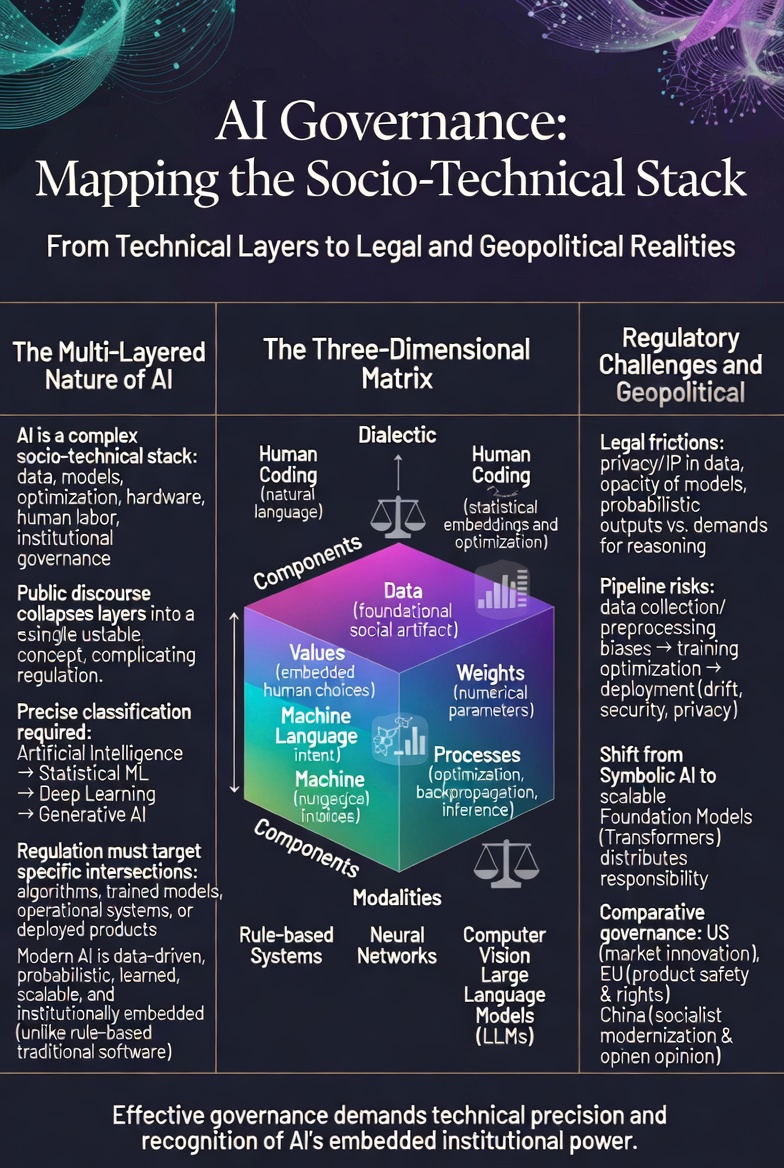
This page includes a summary of the Lecture 1 Notes, as well as this link to the Lecture 1 PPT. Those interested may reach out to me to discuss availability of audio of the lecture and the full text of the Lecture 1 notes. An effective framework for AI governance might start with an analytical shift away from normative judgments about whether specific technical capacities are “good” or “bad” as starting points. Instead, the focus might be rationalized around a structural classification of the objects of regulation and also on the disaggregation of the technical stack to identify exactly what can and will be the object of regulation.
Lecture 1 Abstract
Artificial intelligence is not a singular technology but a complex, multi-layered socio-technical stack comprising data, models, optimization processes, hardware, human labor, and institutional governance. In public discourse, the term “AI” collapses these diverse layers into a single concept—a semiotic instability that presents a severe challenge for legal regulation. Effective AI governance begins with precise technical classification. Regulators cannot intelligently assign liability, duties, or rights without distinguishing between nested technical concepts—moving from the broad field of artificial intelligence to statistical machine learning, deep learning neural networks, and generative AI. Furthermore, governance must pinpoint exactly where law intersects with the technology, determining whether regulation targets a core mathematical algorithm, a trained model, an operational system, or a commercially deployed product.
Modern AI fundamentally diverges from traditional software because it is data-driven, probabilistic, learned, scalable, and institutionally embedded. Rather than executing explicit, hand-coded rules, modern models learn statistical associations from historical data. This shift creates distinct legal frictions: data quality and collection methods raise privacy and intellectual property concerns; probabilistic outputs clash with administrative demands for explicit reasoning; and the self-learned nature of deep learning creates algorithmic opacity, where even developers cannot fully interpret internal model representations.
Regulation must necessarily function around and within what might be understood as the matrix of modern AI: modalities, components, and dialectics. To fully map this technical object, governance must evaluate AI as a three-dimensional matrix defined by its functional modalities, structural components, and a core linguistic dialectic.
The first axis consists of functionally differentiated modalities, which span from primitive rule-based systems to multi-layered artificial neural networks, deep learning computer vision, and large language models (LLMs). Each modality processes information differently and introduces unique regulatory surface areas—whether it is the rigid, discriminatory potential of an explicit rule or the unpredictable, generative risks of an LLM.
The second axis maps the physical and mathematical system components that animate these modalities:
*Data: The foundational social artifact and raw material.
*Values: Human choices embedded during pre-training, parameter tuning, and data labeling.
*Weights: The internal, numerical parameters within a neural network that encode statistical patterns.
*Processes: The continuous computational workflows—such as optimization, backpropagation, and inference—that transform static code into dynamic behavior.Binding this entire matrix together is a profound dialectic between human coding and machine language. Traditional software relies on human-written, imperative instructions that dictate exact logical pathways. Modern AI, however, shifts the human role to setting high-level frameworks (architectures, loss functions, and training boundaries). The system then computes its own “machine language”—an abstract, multi-dimensional vector space of embeddings and weights that humans cannot read line-by-line.
This creates a constant tension: humans try to impose legal, ethical, and operational constraints using natural language, while the underlying technology executes via statistical optimization. This translation gap between human intent and emergent machine capability, between cognition and computation, is the ultimate challenge of modern AI governance.
Because these highly scalable systems are embedded within core societal institutions—allocating resources, credit, and power—technical risks inevitably transform into broad political and legal challenges. This governance dilemma is further complicated by the historical transition from brittle, rule-based Symbolic AI to general-purpose Foundation Models. Powered by the transformer architecture, modern foundation models can be adapted to endless downstream tasks, distributing legal responsibility across original developers, commercial deployers, and end-users. Mitigating these systemic risks requires mapping the entire machine-learning pipeline as a continuous, non-neutral process. Human judgment and institutional bias shape the pipeline long before a model is trained—specifically during data collection, preprocessing, and the assignment of subjective cultural labels. During training, optimization algorithms iteratively adjust internal parameters to minimize a loss function, yet standard post-training benchmarks often mask performance disparities among sub-populations. Finally, the deployment phase introduces inference-level risks, including data drift, security manipulation, and user-input privacy violations.
It might follow that AI cannot be regulated as an abstract, stable entity. It is an evolving process that stretches from the initial transformation of the world into data through to real-time institutional deployment. Ultimately, comparative AI governance is a geopolitical contest over how this technical object is legally constructed. While the United States constructs AI through market innovation and national competitiveness, and the European Union frames it through product safety and fundamental rights, China regulates it through the lens of socialist modernization and state public opinion management. To navigate these conflicting regimes, legal and administrative frameworks must move past superficial definitions and directly govern the specific technical layers, pipeline choices, and institutional realities that make modern AI what it is.
Lecture 1 Summary Lecture Notes: ACCESS HERE
RETURN TO Lecture Series: AI Governance in Comparative Perspective, Theory and Practice: China, U.S. and E.U, With a Sideways Glance at the U.N. (2026) HOMEPAGE
RETURN TO Access Education Initiatives PAGE
RETURN ΤΟ CPE Homepage