

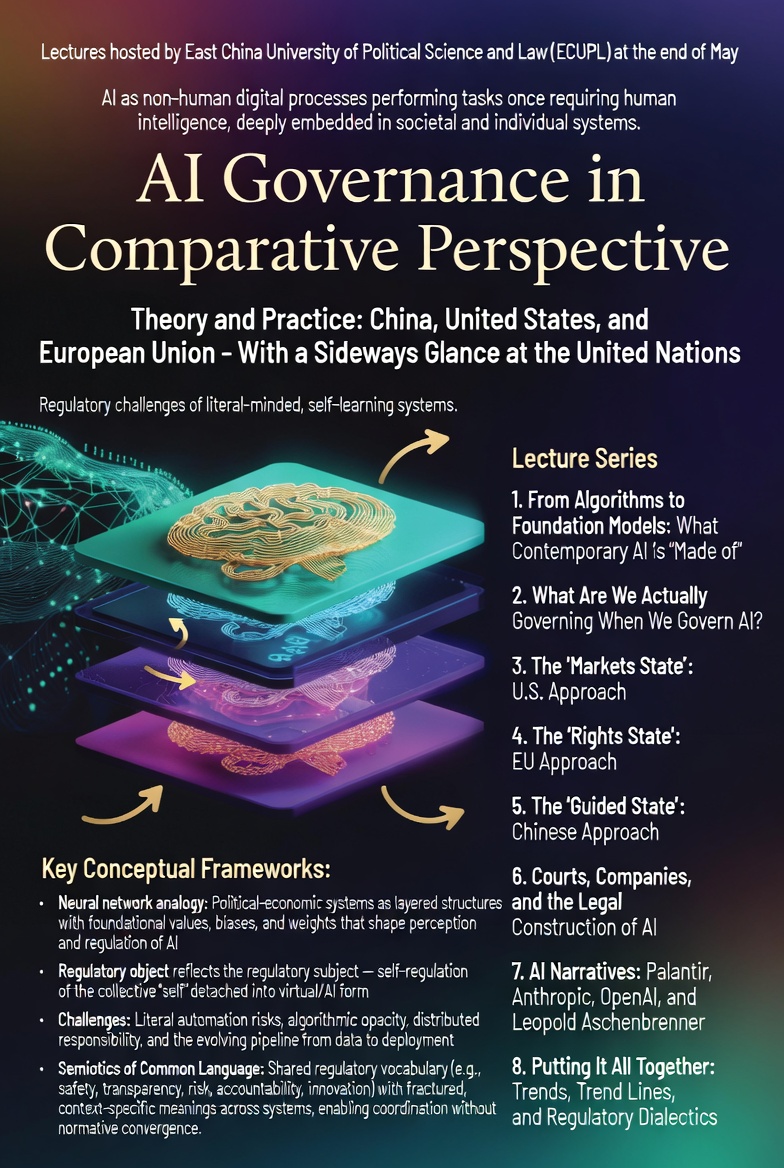
The overall theme (and thus the title) of the lectures was AI Governance in Comparative Perspective, Theory and Practice: China, U.S. and E.U, With a Sideways Glance at the U.N. The subject of the lectures requires little by way of introduction: Artificial intelligence is the broad term that has come to represent a growing cluster of non-human and digitalized processes and operations that has as its primary task the constitution of non-human systems capable of performing tasks that were once thought to require human intelligence. AI has come to dominate , or infect, depending on one’s point of view, virtually every aspect of the organization and operation of collective human systems—as well as shaping the lives of individuals who are plugged into virtual systems of decision making or automated processes that can provide everything from entertainment, to advice, to interaction with other humans and organizational structures. This is well known as is its capacity for literal impact. One is reminded of Norbert Wiener’s reference to the classic horror tale, the Monkey’s Paw, in his book God & Golem, Inc.: A Comment on Certain Points Where Cybernetics Impinges on Religion(MIT Press, 1964, pp. 58-60). The tale describes the risk of wishing for or demanding something from a source that is entirely literal minded, which in the case of the Monkey’s Paw was meant to grant three wishes, the means to those ends were undefined. When a person wished for a sum of money, the wish was granted, in the form of a settlement by their son’s employer as a consequence of an accident that killed the son. In Wiener’s words: “The magic of automation, and in particular the magic of automatization in which devices learn, may be expected to be similarly literal. If you are playing a game according to certain rules and set the playing-machine to play for victory, you will get victory if you get anything at all, and the machine will not pay the slightest attention to any consideration except victory according to the rules.” (Ibid.); unless, of course the rules are constantly changing to embed more and more complex considerations. When the machine becomes self-learning, it can develop its own mechanisms for adding or subtracting considerations as well (rules, norms, values, etc.).
The Lectures start from the premise that before it is even possible to speak about regulation and regulatory systems, and even more so to speak of such systems in or as some sort of comparison (against what standard is yet another problem of course), one must first have firmly in mind two of the critical elements on which any such discussion might be organized. The first requires an effort to grasp, or perhaps better to approach an understanding of, the object of regulation. The second is to have some better sense of the regulatory enterprise, especially its forms, placement, approaches, characteristics and logic; and noy just its forms but its sources and the character of its authority within regulatory collectives including but not limited to the governmental apparatus.
For purposes of these lectures the focus is on three of the more influential subjects of regulation: the United States (Lecture 3), the European Union (Lecture 4), and China (Lecture 6). Mere description of regulatory approaches is no longer particularly useful, since AI programs can now produce descriptive summaries that may be better than anything a human can do (controlling for the hallucinations of either). Each discussion of national legislation starts with an effort to grasp the characteristics of each state’s neural network embedded in and as its political economic model. Those characteristics then shape the approach of each state toward the regulatory object and the character and objectives of regulatory responses. In that context, the United States might be labelled (or named; 鬼谷子 (Guiguzi’s) ming–ming (明名 intelligent naming)) as the “markets state,” the European Union as the “rights state,” and China as the “guiding state.” These labels suggest the baseline weights and values, the scope of what each system identifies and processes, how it perceives value and threat and accordingly regulates. The US is markets driven and suspicious of state interference (for the most part though reshaped by reconstituting efforts after the 1920s and its openness to techno bureaucratic leadership). The European Union may be rights driven and trusting of state leadership the purpose of which might be understood to protect and enhance rights and prevent negative impacts. China is development driven with a specific objective (forward movement along a Socialist Path) guided and led by a vanguard of social forces in the context of which all productive forces of the state might be embedded. These “hidden layers” of the national neural networks then shape the way each formulates the “issue” of AI and fashions a response that both reaffirms the patterning of its foundational structures and in the process reinforces them.
Lectures 6 and 7 then consider two critical areas that have a significant effect on any regulatory project. The first focuses on courts, enterprises, and the legal construction of AI in and as law. Its principle focus is on the way that AI related litigation is both changing traditional areas of jurisprudence (tort, contract, property and the like) and is being changed by it. The second, Lecture 7, then considers the way in which leaders of AI production are seeking to influence approaches to the conceptualization of the relationship between AI and the state, and in the process offer a window into the way that AI leaders re-envision the relationship between AI, the State and the regulation of both.To those ends the recent “concept exercises” or manifestos of Palantir, Anthropic, and Open AI, along with the reflections of an influential voice within the AI elite mainstream, Leopold Aschenbrenner, are considered.
Lecture 8 then attempts to draw the bigger picture. It suggests the way that a shared vocabulary can cover quite substantial differences in approach, values, and objectives in the context of AI and AI regulation. And it suggests the way that weighting the objectives of innovation, risk, and the role of the state affects the way in which common regulatory focus of safety, security, transparency, accountability, innovation, and infrastructure, each with sometimes substantially different regulatory characteristics as a function of the core differences in national “neural networks.” One comes at last to the understanding of the fundamental contradiction of AI and its regulation: the development of a common language across political systems the neural networks of which overlap but are fundamentally incompatible producing conceptions of AI and law that can be coordinated but which cannot converge.